- Aug 23, 2025
How to Learn Classical Piano Online with the Flex Lessons Piano Method
- Joseph @ Flex Lessons
- Piano Tips & Learning
If you want to learn classical piano, you'll need to spend most of your practice time studying classical piano pieces. Ideally, you should start doing this as early as possible in your study of the piano. However, if you are a beginner, it can be incredibly challenging to reach the point where you are actually playing and understanding classical piano music.
There are many famous piano pieces from classical tradition (as well as Baroque, Romantic, and all the rest) that inspire students to take up study of the piano. Unfortunately, you can’t really decide you want to play the piano and then immediately start learning Moonlight Sonata. You have to start somewhere…else.
If you search through various online forums, you’ll typically receive two common suggestions:
Get a teacher
Use a piano method.
It’s true that the right combination of “teacher” and “method” can really get you somewhere. It’s also true that teachers can play an immense role in your education, and they can help you to avoid the “trial and error” process of learning to play. However, if you are looking to learn and play classical piano pieces, the “method” can get in the way and slow you down a bit, even if you have a teacher!
To remedy this, I have created my own method and my own curriculum that I use specifically with adult students who are looking to learn classical piano pieces. In this post, I’d like to explain how it works and how it can be practically applied when studying piano, especially for the first time.
Table of Contents
This is an information packed post that takes about 15 minutes to read. To help you navigate this information, I am including a table of contents below:
What is a Piano Method?
The Problem with Most Piano Methods
What is the Flex Lessons Piano Method?
What about Exam Boards such as ABRSM, RCM, and Others?
The Best Way to Learn Classical Piano (for Beginners)
“Quantity over Quality”
The Importance of Sight-Reading
Easy to Learn Classical Piano Pieces
What about Music Theory?
You Don’t Know What You Don’t Know
A Classical Piano Method for Adults
What is a Piano Method?
The term piano method typically refers to a specific approach to learning how to play the piano. There are many different methods out there, and each one uses a different format and approach.
Many popular piano methods exist entirely as a series of books that are organized according to level. A good example of this would be something like Piano Adventures or Alfred’s Basic Piano Library. While these methods were originally geared towards teaching children, there are adult versions as well.
In my experience, it is somewhat uncommon for a teacher to come up with their own method because these other methods already exist, and they generally work pretty well. Why reinvent the wheel, right?
Typically, a piano teacher would use a particular method such as Piano Adventures or Piano Adventures for Adults to train students how to play. The teacher would follow the curriculum and approach laid out in the method, adapting things as needed to suit their own style and the student’s preferences. Once a student completes a method (which often takes several years, by the way), the focus can shift to whatever style of music is preferred.
In order to be as widely adopted as possible, most methods often sample music of many different genres and styles. While this can be good for students who really don’t know what they like, it’s often problematic for students who want to learn classical piano music.
The Problem with Most Piano Methods
Piano methods can be useful in that they help students encounter important musical concepts at the right time while also playing level-appropriate music. However, there are a few notable drawbacks:
Most methods are designed to be used by a teacher. Methods are generally not self-paced or self-guided and require a teacher to actually implement the approach.
Most methods conclude around the early intermediate to intermediate level. This is still too low to get into any of the major repertoire. Students will still need to find some source of progressive pieces to develop their skills further.
Most methods use a very limited amount of classical repertoire. While this isn’t necessarily a bad thing, it’s not ideal for students who ultimately want to study classical.
Copyright protection applies to most methods. While you would think this would be a good thing, it effectively prevents teachers from developing courses or any sort of online support for students who want to use a popular piano method. Students must pay a teacher to navigate the method, or do so without any help.
Transitioning to classical repertoire after a method can sometimes be very challenging for students. This is because most methods focus on other types of music and only feature a small selection of classical pieces. Additionally, many of these pieces are often simplified arrangements of bigger pieces (and aren’t really representative of actual classical repertoire). Once a student finishes a piano method, they would be ready to learn more, but they would have also had very little exposure to classical repertoire.
If you are looking to experience music by Chopin, Grieg, Beethoven, and many others, the cons may outweigh the pros when it comes to using a typical method. Many methods can feel quite slow and the included pieces might not be relevant to music that you are looking to study. However, almost EVERYONE uses one of these traditional methods! As a teacher, I am honestly surprised that more people don’t take issue with this.
It’s also worth pointing out that most of these methods were recently published and are very much a product of our modern popular culture (especially when it comes to music selections). While these methods may be inspired from tradition in one way or another, they don’t really represent the way that students learned in the past. Believe it or not, piano learning was a thing before Piano Adventures.
Considering this, I prefer to use an approach that focuses on classical selections right from the beginning. I also prefer to avoid simplified arrangements of classical pieces (although I am not strictly opposed). In my experience, I have found that students who are looking to learn classical piano very much appreciate not having to play jazz and pop selections along the way.
What is the Flex Lessons Piano Method?
The Flex Lessons Piano Method refers to the particular way that I teach someone how to play the piano. I developed this method as a classically-focused alternative to traditional piano methods. I use this approach in my online courses as well as in my private lessons.
Here are a few highlights of this approach:
Strong emphasis on counting out loud while playing (when learning music)
Strong emphasis on self-sufficiency
Skills are often practiced in isolation using custom exercises (naming notes, identifying intervals, chords, etc).
Students are encouraged to reduce the difficulty of whatever they are practicing by practicing hands separate, practicing very slowly, or practicing in short sections (or some combination). Reaching a state of “flow” and “ease” with music is encouraged.
Students are taught to allow their wrist to rise and fall while playing in order to develop a strong sensation of arm weight (and avoid the problem of immobile wrists)
Reading skills are developed and reinforced using a “quantity over quality” approach early on. There is an emphasis on reading and playing more music in a slightly less polished way (as opposed to playing fewer things with perfection).
Once a student reaches the intermediate level, the approach shifts to focus on quality. By this point, the reading skills are second nature, and the music becomes more involved.
The Flex Lessons Piano Method is also unique in that it is designed to be taught online through a system of courses (although it was initially based off of my own private teaching). This multi-media approach along with an emphasis on self-sufficiency enables me to essentially leave a trail for students to follow.
This works exceptionally well for adult students, who often need to work around the schedules of others and benefit from setting their own pace.
What about Exam Boards such as ABRSM, RCM, and Others?
ABRSM, RCM, Trinity, etc. are all examples of educational systems with exam boards. This style of music education is another possible alternative to using a piano method, and it's a rather effective one. However, it requires a teacher trained in the relevant institution and has many other associated expenses (exams, books, etc).
If this is something that you are interested in, I do think it’s worth finding a qualified teacher with a good reputation and pursuing this route. However, these educational systems are not complete and generally require supplemental materials (such as extra pieces, etudes, etc). For example, it is generally assumed that students will study more material in a given period of time in addition to pieces and exercises from the exam lists. Unfortunately, many teachers seem to “teach the test” and don't always incorporate this extra material.
I regularly encounter students who only play the pieces from the exam lists (and no others). I’ve worked with students who can play advanced repertoire, but they have only experienced a dozen or so pieces by this point. In other words, they can’t sight read at all because they have barely experienced any music. Additionally, these students only know the specific scales and arpeggios required in the exams, rather than all of them.
The Flex Lessons Piano curriculum is very much inspired from these institutions. However, it is more comprehensive in the specific ways that lead students towards becoming functional musicians. For example, we study 10 pieces per level, rather than just a few. We also learn etudes and focus extensively on sight-reading. In my program, we are purposely trying to become very experienced at the piano.
While my program does lack the examination component, I am still available to personally guide and give feedback, and the pressure on you will be much lower. Once you finish my program, you will have interacted with quite a number of pieces and exercises. This means that you’ll be able to read and explore music on your own! The importance of this cannot be overstated.
The Best Way to Learn Classical Piano (for Beginners)
If you want to learn classical piano, especially if you are a beginner, here is an overview of what you generally should expect:
Learn the basics of reading music.
Learn basic playing patterns (such as pentascales) with proper technique.
Practice super accessible music and exercises that use these basic positions.
Learn more expanded playing patterns (such as scales and arpeggios).
Practice accessible music that takes advantage of these expanded patterns.
Continue to work on music and exercises of increasing complexity.
Of course, the actual experience is much more involved than this. Also, you’ll need feedback from a teacher throughout the process, especially in the beginning. After all, you don’t know what you don’t know!
Generally speaking, any good curriculum is going to look somewhat similar to this. Perhaps some elements are switched around, but the progression is similar. You just need progressive exercises and piano pieces as well as feedback and support along the way. Since the goal in this case is to learn classical piano, it would help if the pieces came from classical and historical tradition.
Also, you’ll notice that I mentioned “learning the basics of reading” first. I believe this is the best approach in the beginning because music is a universal language that can be studied separately from the piano. By removing the piano from the equation, at least temporarily, you’ll learn to read much faster because you have less to think about.
To help students start out on the right path, I created a free course which trains you how to read music for the first time. You can find this course here: https://www.flexlessons.com/piano-essentials
Once you know the basics of reading music, you'll need to spend time reading things that you can actually play and understand. Almost everybody seems to get this wrong! Don’t jump into things that are too difficult and take 6 months to learn. You won’t experience very much music this way.
The best way to learn classical piano is to systematically read classical pieces that are progressive in difficulty and practice related techniques along the way. This essentially forms the basis for my classical piano program!
“Quantity over Quality”
One interesting aspect of my program (that some teachers might scoff at) is the preference towards learning a larger amount of material at a slightly lower standard. This is in contrast to learning a small selection of things and bringing them to a very high standard. Keep in mind, this is only true at the beginning stage of my program. Later on, I do reverse this focus.
This is very important because there is a sizable opportunity cost to focusing on perfection, especially early on. I have found that the amount of material is far more important, provided that basic musical standards are met. Additionally, pieces and exercises that are actually level-appropriate for beginners are often very intuitive. There is no need to linger once the basics are understood.
Later on, the music becomes more complicated and it really needs to be figured out as opposed to simply “read”. This is also intuitive and provides the perfect opportunity to encourage students to explore deeper practice strategies and work on partial or complete memorization.
This “quantity over quality” approach represents one of the aspects of my program that makes it possible to become skilled at sight reading relatively early on. There is simply no substitute for sheer experience. The ability to sight read is very much the gift that keeps on giving. By learning to read well, the world of music really opens up to you and the dependence on a teacher decreases over time.
The Importance of Sight-Reading
Many people misunderstand what sight-reading actually is (as well as how to develop this skill). Sight-reading is best thought of as your “fluid reading ability”, which refers your ability to play music in real time with no rehearsal.
It’s completely normal for your sight-reading ability to be several level levels behind your playing ability. Once you understand this, you’ll feel comfortable learning more challenging pieces (in whatever way is necessary) so long as you make some time for dedicated sight-reading practice using material that is very accessible to you.
In my curriculum, I use a resource called Progressive Sight Reading Exercises by Hannah Smith. This resource consists of roughly 500+ short exercises based on five-finger positions. The exercises start out at an elementary level and progress to become rather challenging, even though they are limited to five-finger positions. In order to avoid overwhelming you, I divide up this book into smaller assignments across 6 piano levels.
Here is the first and last exercise from this book:


The last thing I’ll mention about sight-reading is that it’s quite necessary to become a self-sufficient musician (one that doesn’t require a teacher). If you choose to study with me or use my program, I certainly don’t expect you to stick around for the rest of your life. I understand that you’ll work with me for a period of time, and then move on at some point. It’s very important to me that you leave my program with the skills to learn and study music on your own.
Easy to Learn Classical Piano Pieces
One of the most important components of a classical piano education is the choice of pieces, especially in the beginning. If you go searching for beginner pieces, you are typically going to find one of three things:
Pieces that are too difficult even though they are categorized as “beginner”
Pieces that may be appropriate but exist as part of collections that are generally much more difficult.
Pieces that are appropriate but are very difficult to read due to poor engraving.
It’s no wonder that everyone turns to method books in the beginning, as it seems that these books are the only sources of truly accessible beginner pieces.
As part of my piano classical piano program, I have developed my own repertoire series by carefully choosing individual pieces from the public domain. In many cases, I have re-engraved these scores (engraving is the process of creating sheet music) for clarity and consistency.
This is the first piece from Level 1 in my beginner program:

This is the last piece from Level 3 in my beginner program:
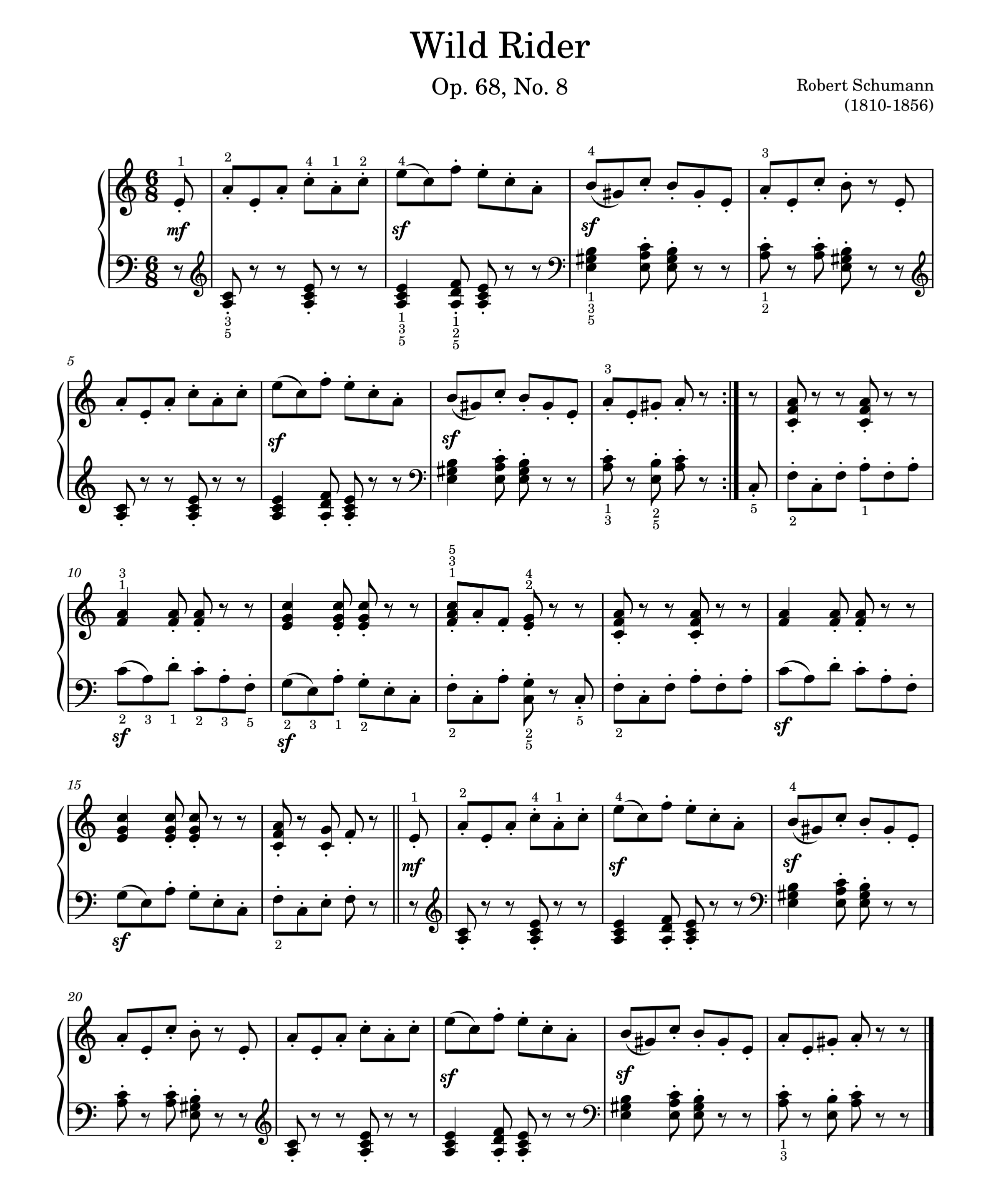
In my classical piano program, there are 10 pieces per level, all arranged in order of difficulty. This music is included as part of the program. These pieces are truly accessible, yet they still provide a good challenge (especially near the end of each level). There are 30 pieces total in my beginner program, and there will be 40 pieces in my intermediate program.
This volume of music, along with other supporting exercises and studies, is how I help students acquire enough experience to truly become skilled at the piano.
What about Music Theory?
Music theory can be thought of as the grammar of music. It encompasses note types, rhythms, scales, keys, chords, and so on. The higher one ascends in terms of repertoire, the more an awareness of music theory becomes necessary.
Considering this, it’s important to not focus too much on music theory early on. For example, it might not be relevant to learn about modes or even serialism while also working on Hot Cross Buns. Even though this is a ridiculous example, I’ve encountered it in the past with students who were so interested in theory that they never got off the ground in terms of their playing ability.
The approach that I take in my method is to divide up the most essential theory elements and match them up with different levels of repertoire. In other words, you’ll learn what you need to learn when you need to learn it. This helps us avoid wasting time, and it also helps to avoid the situation where you might lean into theory far more than as necessary for your playing level.
In my classical piano program, I use a very helpful website called Musictheory.net where I have the ability to link to customized exercises. Here is an example of an exercise that I customized to help beginners practice identifying notes on the bass clef.
In the same manner, I have also customized a large variety of different exercises that focus on reading, interval recognition, chord identification, and so on. As you can see, the musictheory.net website is an incredible resource, and we take full advantage of this in my program.
You Don’t Know What You Don’t Know
Feedback from a skilled piano teacher is critical to becoming successful at the piano, especially where classical repertoire is involved. I would say it’s critical even to leave the beginner phase (which is more involved than you might think).
Good teachers can spot issues within seconds that would never occur to you as a student. In my experience, the process of unlearning a bad habit is such a trial that many students don’t overcome it without a monumental effort. If you are serious about learning piano, especially classical piano, you’ll need a mechanism of course-correction throughout your study.
Normally, a typical piano method would be introduced and taught by a teacher who would then be available to give feedback along the way. This is the main advantage of hiring a teacher and using a method.
In an online setting, especially with courses, this element is often lacking, even if the actual method and curriculum is sound. This is one of the main reasons that people are often skeptical of online learning systems when it comes to learning piano. If you are considering learning in an online format, and there is no teacher to watch you play or evaluate your recordings, you might be making a big mistake with your time and money.
Just so you know, there is still a way to get feedback online! In my classical piano program, not only do I teach all of the material in the form of a systematic series of videos and assignments, but I also make myself available for feedback. I also know of some other teachers who are using a model similar to this. We have all embraced the idea that feedback is critical.
In each course in my program, there is a section for uploading video recordings. These recordings are only viewable by me and other members. I respond regularly to these recordings by offering comments and if necessary, audio, and video recordings.
There is no substitute to getting a teacher’s eyes on your playing, especially early on. The correct and necessary things are not intuitive to most people. If they were, there would be much less need for piano teachers. However, in reality, there is a great need for piano teachers because bad habits are often the natural consequence of self-learning.
Considering classical and historical tradition, we do not come from a lineage of self-learning. The gift of music has been passed on from generation to generation. While technology can greatly aid the process of learning in modern times, it does not replace the need for a teacher to be involved.
A Classical Piano Method for Adults
If you are an adult student who wants to learn classical piano and all that it entails, I truly believe my approach is the one for you. You’ll encounter all the necessary pieces, skills, and concepts to navigate your way through the beginning and intermediate levels of piano study.
Unlike many of the other course-based programs out there, you don’t need to wait for a specific time of year to join. However, your skill level and previous experience determines which variant of my program that you should consider.
If you have absolutely no experience with the piano whatsoever, and you don’t know how to read music, you should start with my free course.
If you have some experience already, you’ll want to join my program as a beginner or intermediate student. Beginners start at Level 1, and intermediate students start at Level 4.
If you have any questions or comments, feel free to leave them below. I hope to work with you soon!